
The version of this comparison you’ll usually find sets $25 an hour against $15 an hour and declares a winner. It’s the wrong arithmetic, in both directions.
Here’s the honest version, with the numbers that don’t appear on either invoice.
The setup
Assume you need roughly 20 hours a week of support. Admin, inbox, scheduling, data, follow-ups. Nothing requiring a licence or a specialist.
Option A: a part-time employee at $25 an hour, 20 hours a week.
Option B: a managed virtual assistant on a monthly plan for the same hours.
What the employee actually costs
Twenty hours at $25 is $500 a week, so $26,000 a year in wages. That’s the number most people compare with. Here’s what sits on top.
Payroll tax. Social Security at 6.2% and Medicare at 1.45% comes to $1,989. FUTA adds about $42. State unemployment, at a new-employer rate of roughly 3.4% on a $9,000 wage base, adds around $306. Call it $2,340.
Equipment. A laptop, a monitor, a headset. Amortised over three years, somewhere around $500 a year — more if you replace on a shorter cycle.
Software seats. Email, project management, CRM, password manager, whatever else they need access to. Realistically $40 to $80 a month, so $500 to $960 a year.
Paid time off. Two weeks plus statutory holidays is roughly 6% of working days. On $26,000 that’s about $1,560 of paid non-productive time.
Recruiting. Job posting, screening, interviewing. If you do it yourself and value your time at $150 an hour, ten hours of hiring is $1,500 — and that’s a conservative ten hours.
Training. The first month is rarely full productivity. Call it three weeks at half output: roughly $750 of wages for work that wasn’t done, plus your own time explaining things.
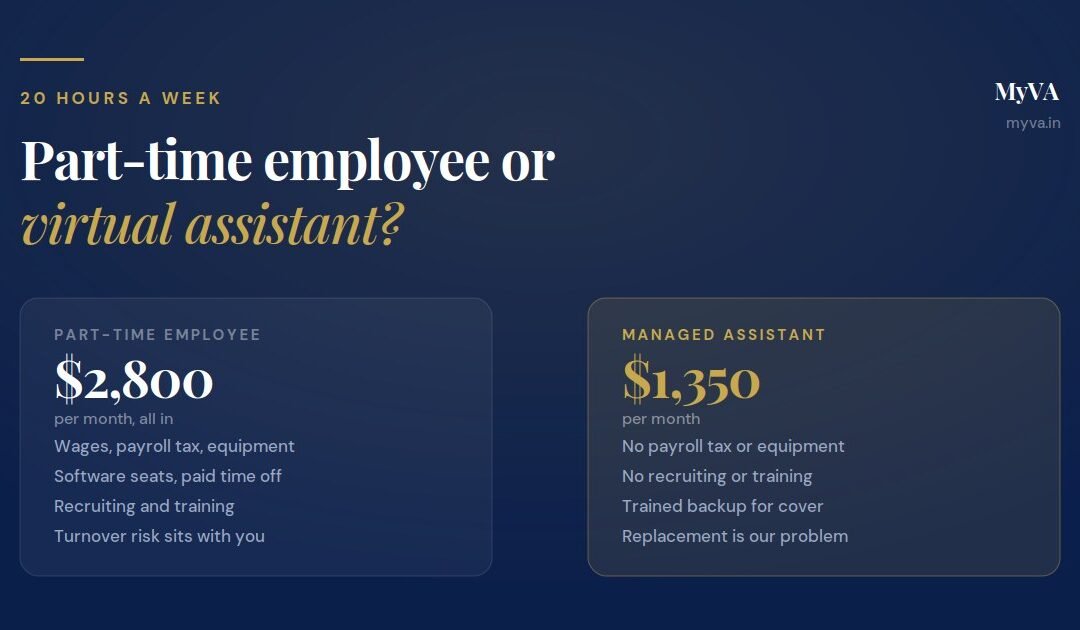
Running total: around $33,500 a year, or $2,800 a month, for 20 hours a week.
That’s before health insurance if you offer it, before workers’ comp, and before payroll software or a bookkeeper to process any of it.
What the VA actually costs
Our Professional plan is $1,349 a month for four hours a day — that’s 20 hours a week. Annually, $16,188.
What’s not on top of it: no payroll tax, no equipment, no software seats, no PTO liability, no recruiting, no training period you pay for.
There is one real cost the invoice doesn’t show. Your onboarding time. Expect to spend three to five hours in the first fortnight explaining how you work — less than hiring, but not zero. At $150 an hour that’s around $600, once.
Running total: roughly $16,800 in year one, then $16,188 after.
The gap, and what it buys
About $16,700 a year. That’s the honest headline, and it’s large enough that the rest of this post matters more than the number.
Because the gap isn’t free. Here’s what you give up.
Physical presence. If the role needs someone to receive post, sign for deliveries, be in the room for meetings, or handle anything paper-based, a remote assistant can’t do it. This ends the comparison for some businesses, immediately.
Exclusivity of attention. An employee is yours. A VA on a managed plan is dedicated to you during your hours, but works within an agency structure.
Direct cultural fit. Someone in your office absorbs how you work by being around it. Remote requires you to articulate what would otherwise be absorbed — which is why writing a few things down first matters more in this arrangement.
Long-term compounding. An employee who stays five years knows your business in a way no arrangement replicates. That’s real, and worth paying for if you can keep them.
What the VA buys that the employee doesn’t
No turnover exposure. Replacing an assistant costs roughly 30 to 50 percent of their annual pay once you count lost productivity and retraining. On a $26,000 role that’s $8,000 to $13,000, and you carry that risk entirely as an employer. On a managed plan, replacement is the agency’s problem.
No coverage gap. When your employee is sick or on holiday, the work stops. On a plan with a trained backup, it doesn’t.
Scale in either direction. Going from 20 hours to 40 means a second hire and another round of everything above. On a plan it’s a message. Scaling down is worse — reducing an employee’s hours or letting them go carries cost, notice and risk.
Someone else supervising. On a managed arrangement, an ops manager reviews output before it reaches you. Employ someone directly and that job is yours, at your hourly rate, every week.
When to hire the employee anyway
We’re a VA agency, so weigh this accordingly — but it’s true, and pretending otherwise wastes your time.
Hire if the work needs physical presence. No remote arrangement solves this.
Hire if you’re building a team you’ll grow into. A first employee who becomes an operations manager in three years is worth far more than the arithmetic suggests.
Hire if the work is genuinely specialised to your business in ways that take a year to learn, and you’re confident you can retain someone that long.
Hire if you want an employee. Some people want colleagues rather than suppliers, and that’s a legitimate reason that doesn’t need justifying with a spreadsheet.
When the VA is the better call
When the work is documented-able. Admin, coordination, data, marketing production, follow-ups.
When you can’t commit to permanence. If 20 hours might become 10 next quarter, an employee is an expensive way to find out.
When you’ve tried hiring and it didn’t stick. Two failed part-time hires cost more than a year of managed support, and the second one usually fails for the same reason as the first.
When you don’t want to be a manager. This is the real dividing line. An employee needs managing — hiring, supervising, reviewing, developing, and eventually replacing. If you want the outcome without the management job, that’s precisely what you’re buying.
The short version
A $25-an-hour part-time employee costs roughly $2,800 a month all in. Twenty hours of managed VA support is about $1,350. The gap is real and so is what it buys — presence, permanence, and someone who’ll still be there in three years.
The rate was never the question. The question is whether you want an employee or an outcome, and those are different purchases.
Our plans and prices are on the services page, including a two-week pilot at $399 if you’d rather test the arrangement than commit. Or run the two-minute delegation audit to see how many hours you’d actually be handing over.
How many hours a week are you giving away?
Six questions. You’ll get the hours you’re losing to work someone else could do, what that time is costing you, and the first three tasks worth handing over — in the order that actually works.
Start the audit