
Last week’s post argued that most delegation fails from bad sequencing rather than bad hiring. There’s a version of the problem that happens earlier, before anyone is hired at all.
You hand over a task. Your assistant does it slightly wrong. Not badly — just not the way you’d have done it. So you explain again, adding the detail you forgot to mention. They do the next one. It’s wrong in a different way, because there was another detail you also forgot.
That loop isn’t a competence problem. It’s that the process only ever existed in your head, and heads are bad at exporting.
The fix is unglamorous: write some of it down first. Not all of it, and not properly. Here’s the short version of what’s actually worth the effort.
Write down the decisions, not the clicks
The instinct is to document the steps. Open this, click that, paste it here.
Steps are the easy part. Anyone competent works out the clicks in a day. What they can’t work out is why you do it that way — and that’s where the re-explaining happens.
So instead of “add the lead to the CRM and tag them,” write down the thing underneath it: leads from the website get tagged as warm, leads from a purchased list get tagged cold, and anything from a referral gets flagged for me personally.
The first version tells someone what to press. The second tells them what to do when they hit a case you didn’t anticipate — which happens in week one, every time.
The five things worth writing down
You don’t need a manual. You need five short documents, and none of them should take more than fifteen minutes.
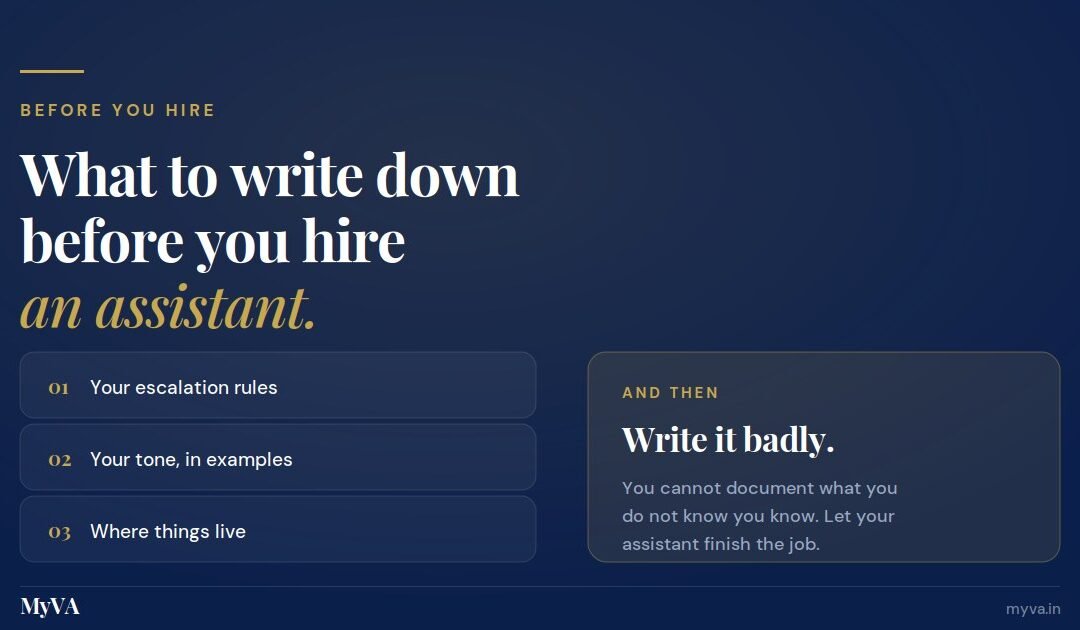
1. Your escalation rules. What should never be handled without you? What can they decide alone? Where’s the line between “just do it” and “ask first”? Most week-one friction comes from an assistant guessing at this boundary and guessing wrong in either direction — either bothering you constantly or making a call they shouldn’t have.
2. Your tone, in examples. Don’t describe your voice. Paste three emails you’ve actually sent — one to a new prospect, one to a client mid-project, one delivering bad news. Examples transfer tone far better than adjectives. “Friendly but professional” means nothing; three real emails mean everything.
3. Where things live. Which drive, which folder, which naming convention, which tool holds the source of truth for what. This sounds trivial and it’s the single biggest time sink in the first fortnight. Half of early back-and-forth is just someone asking where something is.
4. Your recurring rhythm. What happens weekly, monthly, quarterly. Invoices on the first, reports on Friday, follow-ups every Tuesday. Anything on a cycle can be handed over almost immediately, because the trigger is a date rather than your judgment.
5. The exceptions. The clients who get treated differently. The vendor who needs chasing twice. The one report that goes out in a different format because someone asked in 2023. These live entirely in your memory and they’re the ones that cause visible mistakes — the kind a client notices.
Write it badly
The reason people don’t document is that they picture a proper SOP library, get tired thinking about it, and do nothing.
Voice notes count. Bullet points count. A messy Google Doc counts. Screen recordings count, and are often faster than writing — talk through a task while you do it once, and you’ve documented it.
The bar isn’t polish. The bar is: could someone follow this without asking you?
Let your assistant finish the job
Here’s the part that saves the most time, and most people miss it.
Don’t try to write everything before they start. You’ll fail, because you genuinely don’t know what you know until someone asks. The gaps are invisible from the inside.
Write the five things above. Then have your assistant document everything else as they learn it. Every time you explain something, they write it down. Within a month you have a real process library that cost you nothing extra, written by the person who actually needed it — which means it’s written at the right level of detail rather than yours.
That’s also a decent test of a good assistant. Someone who documents as they go is going to be easier to work with in month six than someone who keeps asking the same question.
What this actually buys you
Two things.
Week one stops being painful. Most of the friction is the same handful of missing details. Cover them in advance and the first fortnight looks like work getting done instead of a training exercise you’re regretting.
The next hire is faster. The documentation outlives the person. If your assistant moves on, or you add a second, or you eventually hire in-house, the process is already written. Most solo operators rebuild this from scratch every time, which is why hiring feels harder each round rather than easier.
An hour of writing before you start saves several weeks of explaining. That’s the whole argument.
If you’re not sure what’s worth handing over in the first place, our two-minute delegation audit works out the hours you’re losing and the first three tasks to move. Or read why the order matters more than the list.