
Search for what to delegate to a real estate virtual assistant and you’ll find the same list about eight times over. Twelve tasks, twenty-two duties, the ultimate checklist. CRM management, MLS updates, showing coordination, transaction paperwork, social media, lead follow-up.
The lists aren’t wrong. They’re just not the hard part.
The hard part is that you can’t hand over twelve things at once, so you have to pick a first thing — and most agents pick badly. Not because they’re careless, but because the instinct that drives the choice is the wrong instinct.
Most agents delegate whatever annoys them most
It’s a reasonable-sounding move. You’ve got a VA, you’re paying for hours, so you hand over the job you’ve been dreading for six months.
That job is almost always the one you’ve never written down. It’s messy, it’s got exceptions, and half the process lives in your head and nowhere else. You dread it precisely because it’s unstructured.
So week one goes like this. You explain the task. The VA does it slightly wrong, because you left out three things you didn’t know you knew. You fix it. You explain again. By Thursday you’ve spent more time supervising than the task ever took you, and you’re wondering whether this was a mistake.
Nothing was wrong with the VA. You picked a first task that couldn’t be taught in a week.
The first thing you delegate should be slightly boring
The job of the first task isn’t to save you the most time. It’s to build a working relationship where both sides learn how the other operates, while the stakes are low enough that mistakes cost nothing.
That means the ideal first task is repetitive, has a clear right answer, and won’t reach a client if it goes wrong.
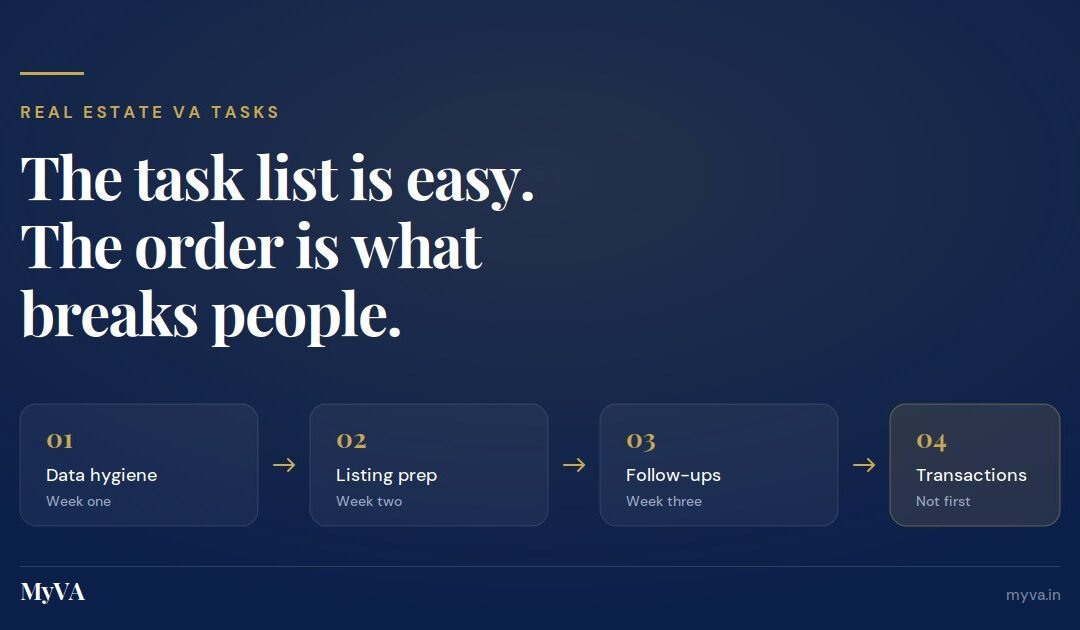
Start with data hygiene. Your CRM has duplicate contacts, half-finished records, leads tagged from a campaign three years ago, and people who’ve moved twice since you met them. It’s dull work, it’s completely rule-based, and it’s genuinely valuable — every follow-up system you build later runs on this data, and right now the data is dirty.
More importantly, it’s forgiving. If your VA merges two records incorrectly in week one, you fix it in thirty seconds. If they email the wrong client in week one, that’s a different kind of conversation.
Then move to listing preparation. Not the listing itself — the assembly. A listing launch involves property details, photo coordination, MLS-ready copy, disclosures, showing instructions, open house materials, social posts, and status tracking. That’s a checklist pretending to be a scramble, and it’s the clearest early win available.
The reason it works second rather than first is that by now your VA has spent two weeks inside your data. They know your neighbourhoods, your price bands, your repeat clients. That context is what makes the listing work good rather than merely completed.
Third, follow-up sequences. Once the data is clean and they understand your listings, they can run the follow-up cadence that you currently do from memory and therefore don’t always do. This is where the delegation starts genuinely paying, and it’s only possible because of the two boring things that came first.
The task everyone tells you to delegate first is the one to delegate fourth
Most guides point at transaction coordination as the highest-value thing to hand over, and by dollar value they’re right. Deadlines, title and lender coordination, document prep, keeping all parties updated — it’s real work with real leverage.
It’s also the worst possible starting point.
Transaction coordination is high-stakes, deadline-driven, and involves your clients directly. A missed date has consequences that a merged contact record does not. It requires someone who already knows how you communicate, what your clients expect, and which lenders need chasing twice.
That’s a month-two or month-three task. Handing it over in week one is how people conclude that delegation doesn’t work for them.
What never leaves your desk
Worth being clear on the boundary, because it’s not negotiable and it’s not a matter of trust.
Anything requiring your licence stays with you — preparing offers, negotiating, advising on price, anything a client could reasonably construe as professional advice. Your VA can assemble the comps; you interpret them. They can draft the caption; you approve anything compliance-sensitive. They can organise the file; you make the calls that carry liability.
The test that holds up: if it needs your licence, your relationships, or your judgment, it’s yours. If it’s a documented process someone could follow from a written page, it can move.
The layer above the task list
There’s a point, usually a few months in, where task delegation stops being the constraint and the systems become the constraint. You’ve got a VA doing good work, but your numbers still live in four spreadsheets and your sense of profitability is a feeling rather than a figure.
That’s the stage where the useful thing to build isn’t another delegated task but a place for the information to live. For one agent we work with, that meant a single connected system in Google Sheets — commission tracked against their actual split structure, operating expenses in the same place, a profit summary that updates itself, and a sync with their CRM so the data stays current without anyone re-keying it.
The commission calculator wasn’t the interesting part. The interesting part was that once it existed, questions that used to take an afternoon of spreadsheet archaeology took about ten seconds. That’s a different kind of time saving than “someone else does my data entry,” and you can only get to it after the basics are running.
A first month that usually works
Week one — CRM cleanup and data hygiene. Low stakes, high learning.
Week two — Listing assembly, following a checklist you write together as you go.
Week three — Follow-up sequences and calendar management. First tasks that touch clients, with you reviewing before anything sends.
Week four — Review honestly. What took longer than expected? What did you have to re-explain twice? Those are the gaps in your documentation, not failings of the person.
Only after that month do you hand over transaction coordination, and only if week four went well.
The part nobody puts in the list posts
Delegation fails far more often from bad sequencing than from bad hires. The task list is the easy half — you can find it on any of a dozen sites, including this one now.
The order is the half that decides whether you’re still delegating in six months, or whether you quietly took everything back in week three and told yourself you’d try again next year.
Start with something boring. Build from there.
MyVA places managed virtual assistants with real estate professionals across Canada and the USA — every assistant approved by you before work starts, and a Customer Success Manager reviewing output before it reaches you. See our work or book a free 15-minute call to talk through what’s worth handing over first.
Practical notes on delegating well
What we’re learning from running operations for founders, agents, and small teams across Canada and the USA. No pitches, no filler — one useful email a month, and you can leave whenever you like.