
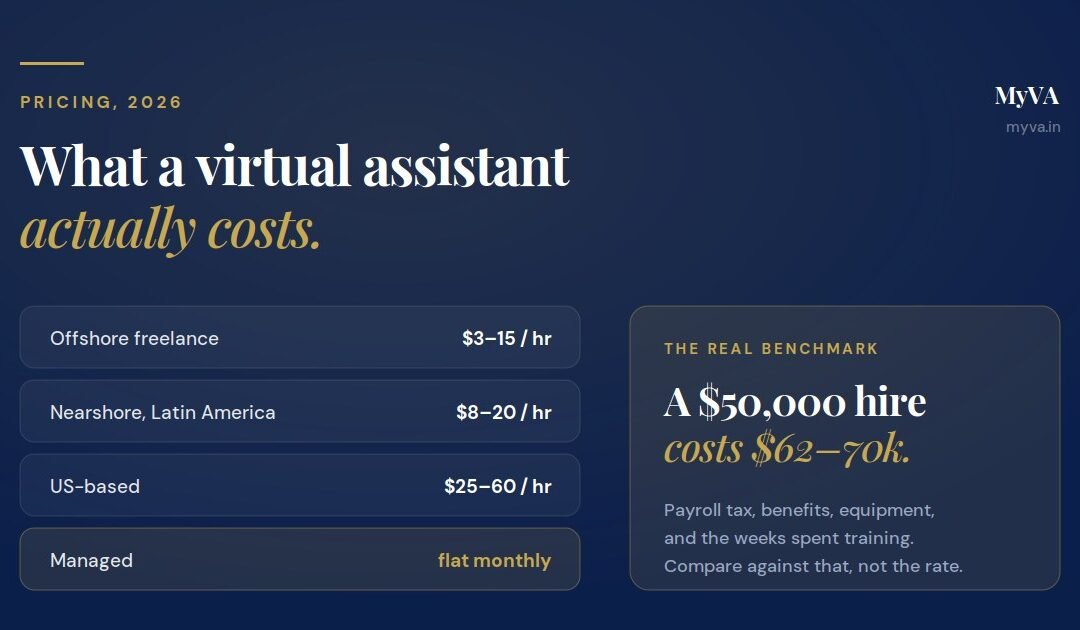
Most guides answering this question give you a range and leave it there. Three to sixty dollars an hour, which is true and useless — it’s the same as saying a car costs between four thousand and four hundred thousand dollars.
The rates cluster into bands, and the band tells you what you’re actually buying. Here’s the breakdown, with our own prices published at the bottom rather than hidden behind a discovery call.
The four bands
- Offshore freelance: roughly $3 to $15 an hour. The big marketplaces. Upwork’s median for freelance VAs sits around $13. You do the hiring, training, managing and replacing yourself.
- Nearshore, Latin America: roughly $8 to $20 an hour. Overlapping timezones, moderate premium over offshore.
- US-based: $25 to $60 an hour, higher in major metros or for specialised work like paid media or IT support. Executive-level assistants run higher still.
- Managed services, a flat monthly fee. Sits between the offshore and US-based bands, with the management included rather than landing on you.
That US-based band deserves a moment. At $40 an hour, mid-range, four hours a day comes to roughly $3,400 a month. Full-time roughly doubles it.
What an employee actually costs
The honest comparison isn’t freelancer versus VA. It’s whether to hire at all — and the salary line understates it considerably.
Take an administrative assistant at $50,000. On top of that:
Social Security at 6.2%, on wages up to the 2026 base of $184,500. That’s $3,100.
Medicare at 1.45%, uncapped. $725.
FUTA at an effective 0.6% after the state credit — capped at $42 per employee.
SUTA, which varies by state, industry and your claims history. A new employer at 3.4% on a $9,000 state wage base pays around $306.
That’s roughly $4,170 in payroll tax alone, before benefits. Budget 7.5% to 10% on top of gross wages for federal employer taxes, plus another 1% to 4% for state obligations.
Then everything that never makes the comparison: health insurance, paid time off, workers’ comp, a laptop, software seats, recruiting time, and the weeks where someone is learning rather than producing. Once benefits are included, the true cost of a hire typically runs 25% to 40% above base salary.
So a $50,000 assistant realistically costs $62,000 to $70,000 — somewhere around $5,200 to $5,800 a month.
None of that argues against hiring. It argues for knowing the real number before comparing anything to it.
What the cheap end actually costs
The $3 to $15 band is real, and people do get value from it. It’s also where most failures happen, for a consistent reason.
The published rate excludes the recruiting, training, managing and replacing — costs that often double the true hourly rate once counted.
There’s a sharper version. Replacing an assistant runs roughly 30% to 50% of their annual pay once you count lost productivity and retraining. Do that twice in a year and the cheap option stopped being cheap around month five.
The other cost is yours. Someone paying $8 an hour and spending five hours a week supervising hasn’t saved money — they’ve converted a cash cost into a time cost and stopped measuring it.
Our numbers
We publish these, which is unusual enough in this industry to be worth saying plainly.
Pilot — $399. Two weeks, twenty hours, credited in full toward your first month. For people who’d rather test the arrangement than commit to it.
Essential — $749 a month. Two hours a day, Monday to Friday. One dedicated assistant, the same person every day, working your hours in your timezone.
Professional — $1,349 a month. Four hours a day. Dedicated assistant plus a trained backup so nothing stalls when someone’s away, a named Customer Success Manager, and design, social and website work included.
Executive — $2,199 a month. Full-day coverage, a specialist pool for design, web and data, and one automation built for you every quarter.
Team — custom. Three or more assistants working as a pod with an account director.
One thing worth stating directly: our assistants aren’t US-based. They work US hours, and every engagement is managed — someone reviews the output before it reaches you, which is the actual difference between this and a marketplace. But we’re not going to imply a domestic team, because you’d find out and it would be a poor way to start.
How to actually choose
Not by the hourly rate. Three questions get you further.
How many hours a week can you spend managing someone? More than three and a freelancer is workable. Under one and an unmanaged arrangement fails regardless of price.
What happens if they disappear next Tuesday? If the answer is “inconvenient,” rate matters most. If it’s “several things break,” you’re buying continuity, and should price accordingly.
What’s an hour of your own time worth? At $150 an hour, ten hours a week of admin is $6,500 a month of your capacity. Against that, almost every option here is cheap — and the real question stops being price and becomes whether the work gets done properly.
The short version
A $50,000 employee costs you $62,000 to $70,000. A US-based freelance VA runs $3,000 or more a month for meaningful hours. Managed support sits below both, and the gap reflects the market rather than a discount anyone’s doing you.
The rate is the easiest number to compare and the least useful one. What decides whether this works is whether the management is included — because if it isn’t, that job is yours, and it’s the most expensive hour in your business.
Our full pricing is on the services page, including the two-week pilot. If you’d rather work out how many hours you’d actually hand over before looking at any of it, the two-minute delegation audit gives you the number and the first three tasks.
How many hours a week are you giving away?
Six questions. You’ll get the hours you’re losing to work someone else could do, what that time is costing you, and the first three tasks worth handing over — in the order that actually works.
Start the audit