
Most delegation fails before the work starts.
Not because the assistant is slow or careless, but because the brief was written the way we all write messages to ourselves: three-quarters of the context stays in your head, and the sentence that does make it onto the page assumes the reader already knows the rest.
If you’ve ever handed something off and got back work that was technically what you asked for and completely not what you meant, the problem wasn’t effort. It was the brief.
Learning how to delegate tasks effectively mostly comes down to learning how to write one good brief. Here is what a bad one looks like, and what fixes it. Same task, written twice.
The task
You’re a real estate agent. You held an open house on Saturday and 14 people signed in. You want them followed up with.
The bad brief
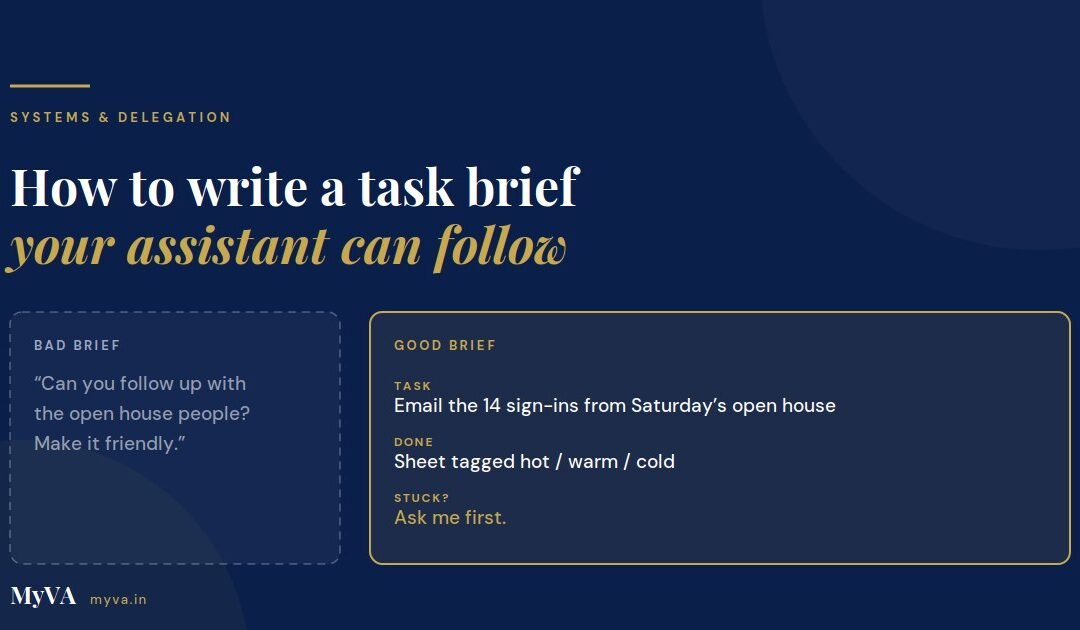
Hey, can you follow up with the open house people? Make it friendly. Let me know when it’s done.
That took eleven seconds to write, and it feels complete. You know what “the open house people” means, you know what “friendly” sounds like, and you know what “done” looks like.
Your assistant knows none of those three things.
The good brief
Task: Follow up with everyone who signed in at Saturday’s open house at 42 Maple Street.
Why: I want to know who’s seriously looking and who was just browsing, so I can spend my calls on the right people.
Who: The 14 names on the sign-in sheet (photo attached). Skip the two marked “neighbour” — they’re not buyers.
What to send: An email today, and a text tomorrow only to anyone who gave a mobile number. Use the template in the shared folder, called “Open House Follow-Up.” Change the first line to mention something specific to this house, using the details in the listing notes.
Done looks like: A tab in the open house spreadsheet with each person’s name, whether they replied, and one of three tags: hot, warm, or cold. Anyone who replies asking about price or a showing: message me straight away, don’t wait for the summary.
Deadline: Emails out by 3pm today. Spreadsheet updated by end of day Monday.
If you’re unsure: Ask me before sending. I’d rather get a question than a wrong email.
That took about four minutes to write. It will save you an hour.
Side by side
| Bad brief | Good brief | |
|---|---|---|
| What | “Follow up with the open house people” | Follow up with the 14 sign-ins at 42 Maple Street, skipping the two neighbours |
| Why | Not stated | To sort serious buyers from browsers so calls go to the right people |
| How | “Make it friendly” | Use the saved template; personalise the first line from the listing notes |
| Channel | Left to guess | Email today; text tomorrow, only to those who gave a mobile number |
| Done | “Let me know when it’s done” | A spreadsheet tab with replies and a hot / warm / cold tag per person |
| Urgent exceptions | None | Anyone asking about price or a showing: message immediately |
| Deadline | Not stated | Emails by 3pm today, spreadsheet by end of day Monday |
| If stuck | Not stated | Ask first, don’t guess |
Look at the left column. Every blank in it is a decision your assistant has to make on your behalf, with no information. Sometimes they’ll guess right. The point of a brief is to stop relying on that.
How to delegate tasks effectively: the six things every brief contains
You don’t need a template to remember these. You need six answers.
1. What exactly is the task? Name the thing, not the category. “Follow up with the open house sign-ins” is a task. “Handle the open house” is a mood.
2. Why does it matter? One sentence. This is the most skipped line in any brief, and the most useful. An assistant who knows why can make a hundred small decisions correctly without asking you about any of them.
3. What does done look like? Describe the finished thing: a spreadsheet tab, a sent email, a booked slot, a folder with eight files in it. If you can’t picture the finished state, the assistant won’t be able to either.
4. Where are the materials? The template, the login, the photo, the previous version. A brief that says “use the usual format” is only a brief if the reader knows what the usual format is.
5. When, and what’s urgent? A deadline, plus any exception that should interrupt you. Without this, everything is equally urgent, which means nothing is.
6. What should they do if they’re stuck? Tell them. “Ask me first” and “use your judgement and tell me after” are both fine answers, but they produce very different weeks. Pick one on purpose.
“But that takes longer than just doing it myself”
The first time, yes.
This is the objection that keeps people stuck doing everything, so it’s worth being direct about it: a four-minute brief for a task you do once is a bad trade. A four-minute brief for a task you do every week is the best four minutes you’ll spend this month.
The better move is to write it once, save it, and reuse it. The second time, you change two details and send. The third time, your assistant doesn’t need you to write it at all, because it’s already a documented process. That’s the actual goal: not better messages, but fewer of them.
A useful rule of thumb: if you’ve explained the same thing twice, the third time it becomes a saved brief.
A short test before you hit send
Read your brief as if you’d never met yourself. Then ask:
- Could someone do this with the brief alone, and no other context?
- Would two different people produce roughly the same thing from it?
- Is there anywhere “you know what I mean” is doing the heavy lifting?
If the answer to the first two is no, or the third is yes, you’ve found what’s missing.
One more thing, and it matters
A good brief isn’t only about being clear. It’s about making it safe to ask questions.
The line “If you’re unsure, ask me first” does more for the quality of your delegated work than any other single sentence you can write. Assistants who are afraid of seeming slow will guess. Assistants who’ve been told that questions are welcome will ask, and the wrong email never goes out.
Not sure what to hand off first? The free delegation audit takes about two minutes. Six questions, and it shows roughly how many hours a week you’re losing and which three tasks to delegate first.