Most discovery calls are designed to feel good. You describe your problem, the agency nods, and forty minutes later you’ve been agreed with so thoroughly that signing feels like the obvious next step.
That’s not a scam. It’s just what a sales call is. The trouble is that the things which actually go wrong in a VA relationship — coverage gaps, handover chaos, work that quietly sits outside what the team is good at — almost never come up, because nobody asks about them while everyone is being agreeable.
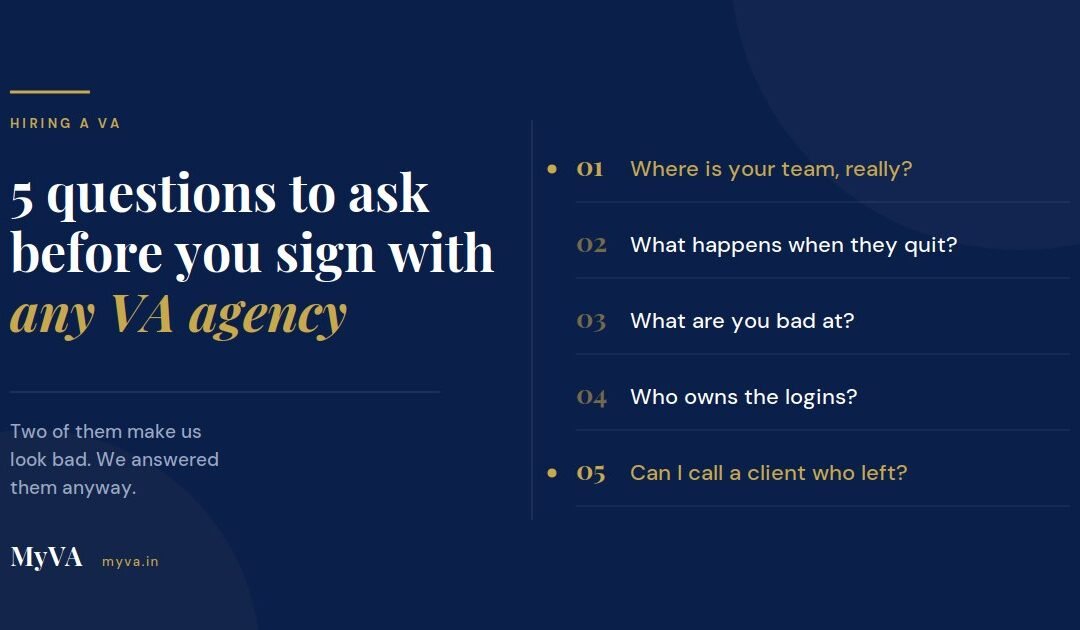
So here are five questions to ask a virtual assistant agency before you sign anything. Two of them are uncomfortable for us to answer. We’ve included our own answers below each one, because an article telling you to ask hard questions is worthless if the people who wrote it won’t sit still for them.
1. Where is the person doing my work, and what hours will they actually work?
A surprising number of agencies answer this with a region rather than a country, or with “our team is global.” That’s a dodge, and it usually means the answer is one you might not love.
Ask for the country, and ask for the working hours in your time zone — not theirs. Then ask what happens when you need something at 4pm on a Thursday. There’s a real difference between an assistant who overlaps your afternoon and one who picks up your message the following morning.
What a good answer sounds like: a specific country, specific hours in your time zone, and an honest description of what falls outside them.
What a bad answer sounds like: “We have coverage 24/7.” Very few small agencies genuinely do. What they usually mean is that somebody, somewhere, will eventually read it.
Our answer: our team works from India, on North American hours. That’s a real overlap with most of your working day, not a workaround — but it isn’t the same as someone sitting in your city, and you should price that into your decision rather than find out in month two.
2. What happens the week my assistant is sick, on vacation, or quits?
This is the single most useful question on the list, and almost nobody asks it during the honeymoon.
Every VA relationship eventually meets this week. The difference between agencies is whether they’ve planned for it or whether they’ll improvise while your inbox backs up.
What a good answer sounds like: there’s documentation, someone else can read it, and here’s roughly how long the handover takes.
What a bad answer sounds like: “That won’t happen.” It will.
Our answer: this is exactly why we document processes from the first week instead of waiting until someone needs them. It’s also, honestly, the strongest argument for using an agency at all rather than hiring a freelancer directly — a freelancer who disappears takes the whole system with them.
3. What are you bad at?
Ask it exactly like that. The answer tells you more about an agency than the entire rest of the call.
An agency that says “nothing, really — we do it all” is either inexperienced or selling. Everyone is bad at something. Teams that know what they’re bad at have been doing this long enough to have noticed, and they’ll route you elsewhere instead of taking your money for work they’ll do badly.
What a good answer sounds like: two or three specific things, named without flinching, ideally with a referral attached.
What a bad answer sounds like: a reframed strength. “We’re bad at saying no to clients” is not an answer, it’s a job interview cliché.
Our answer: we’re a web design and operations team. We’re not bookkeepers, we’re not lawyers, we don’t do cold calling, and we don’t do anything that requires a professional license in your state or province. When somebody asks us for those, we say so.
4. Who owns the accounts, files, and documentation if I leave?
Ask this before you sign, not while you’re leaving. Once the relationship is ending, the incentive to be generous is gone.
The specific things to nail down: who holds admin on the accounts, whether the documentation your assistant wrote goes with you, and how much notice you need to give.
What a good answer sounds like: you own everything, admin sits with you from day one, and the notice period is short and written down.
What a bad answer sounds like: anything vague, and especially any arrangement where the agency holds the master logins to your own tools.
Our answer: you keep the accounts and the documentation. We work inside your tools under your ownership, and there’s no contract locking you in — which cuts both ways, because it means we have to keep earning it monthly.
5. Can I speak to a client who stopped working with you?
This is the one that makes everybody squirm, us included.
Anybody can produce a happy current client. A former client tells you something far more useful: what this agency is like when the fit isn’t perfect, and whether they handled the ending like professionals.
You may not get this one. Some agencies genuinely can’t share it — a departed client is under no obligation to take your call, and it’s reasonable for an agency to say they’d rather not ask. But watch how they decline. “We’d rather not put a former client on the spot, but here’s honestly why that engagement ended” is a real answer. Pretending nobody has ever left is not.
The point isn’t the answers
It’s how the answers are given.
Any agency can rehearse good responses to all five of these. What’s harder to fake is the texture of someone who’s been asked something uncomfortable and decides to just tell you. Hesitation is fine. Specifics are the signal. Smoothness, oddly, is the warning.
If you ask all five and the call gets a little awkward — that’s the call working.
Thinking about delegating but not sure what to hand over first? Take the free delegation audit — six questions, and you’ll see roughly how many hours a week you’re losing and which three tasks to offload first.